Estate Planning
Lead Follow-Ups
Convert more of your unsigned leads.
We find most law firms’ follow-up efforts lacking.
At many law firms, follow-up does not exist. If a prospective client does not schedule an appointment or sign up after a consultation, nothing happens. No calls are made, texts are sent, or educational materials emailed.
This is a glaring omission that costs law firms a meaningful amount of new business.
We can remedy it with either an omni-channel follow-up series or a simple email lead-nurturing series. Examples of both formats are displayed below.
Omni-channel follow-ups
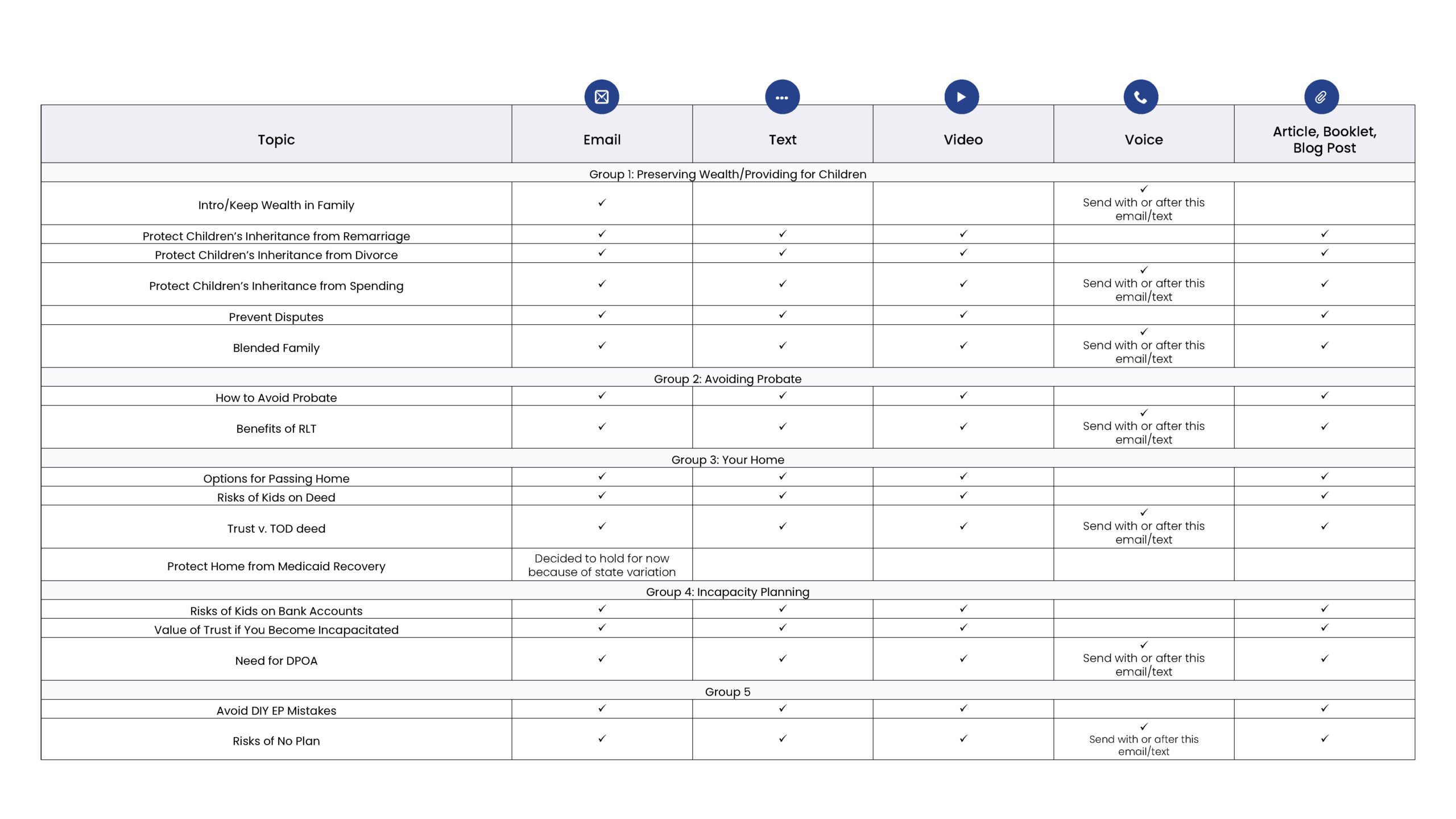
Email follow-ups
20 emails
Subject: Can You Prepare Your Own Estate Plan?
The prevalence of do-it-yourself options for drafting estate planning documents leads many people to wonder whether they can prepare their own estate plans. For all but the simplest estates, however, writing your own estate plan is not a good idea. Estate planning is not a one size fits all model.
These do-it-yourself forms, whether found in books or online, are generated by estate planning computer software that is designed to cover only the most basic of estate planning needs. Even books and programs about estate planning recommend that you seek the expertise of an experienced estate planning attorney.
Self-drafted estate planning documents are notorious for mistakes. Some common problems include:
- Making a gift of one or more specific assets to a particular person without considering what will happen to that person’s inheritance if you no longer own the asset when you die. As a general rule, if your will attempts to give away an asset you no longer own, the gift lapses and the beneficiary isn’t provided with an alternative gift.
- Not providing alternative beneficiaries who would take if the first named person predeceases you. In this case, do you want the deceased beneficiary’s gift to go to his or her heirs or to someone else?
- Failing to provide for what should happen to property in your estate that you have not specifically mentioned in your will. The property could be omitted through oversight; it could have been acquired after the will was drafted; or its intended beneficiary could have predeceased you and you did not name an alternate.
- Failing to provide for the possibility that you may have more children after executing your documents. States have laws designed to protect children born after a will is executed from being unintentionally disinherited. These laws vary and are not a guarantee.
- Not executing your estate planning documents with the legally required formalities.
A document that is improperly executed is not valid. In most states, a will must show the testator’s intent to make a will; the testator must have testamentary capacity; the will must be signed by the testator in the presence of two witnesses who watch the testator sign the will and then sign it themselves. The witnesses must also be disinterested parties, which means they are not beneficiaries under the will. Other estate planning documents require similar execution procedures.
Estate planning is a complex endeavor that puts clients at risk for many mistakes. Working with an experienced professional will ensure that you avoid them.
Subject: Providing for Minor Children
If you are a parent of minor children, one of your estate planning priorities may be to leave an inheritance for the children. Leaving an inheritance directly to a minor creates a problem. Minors cannot own more than a few thousand dollars worth of property outright. Larger amounts must be under adult management. If your trust or will leaves substantial property directly to a minor, a court proceeding will be necessary to appoint a guardian or conservator to oversee the property. A court proceeding is undesirable because it will take time, cost money, could cause conflict if different people vie for the appointment, and leaves you no say in who is appointed.
Better options for leaving an inheritance to a minor are:
Leave the gift to one of the child’s parents with the understanding that the parent is to use it for the child’s benefit. Married parents frequently choose this alternative. Each leaves all his or her property to the other in a will or living trust with the understanding that it will be used to support the family. Obviously, this alternative won’t work if the child has no surviving parent or the other parent is financially incompetent or untrustworthy.
Name a custodian under the Uniform Transfers to Minors Act (UTMA) to manage the gift. Most states have enacted this law. In your will or living trust, you specify that you are leaving the inheritance to the custodian for the child’s benefit under your state’s Uniform Transfers to Minors Act. The custodian can manage the property without court supervision. However, he or she must manage it prudently and spend it for the child’s benefit. Once the child reaches the age specified in the law (18 or 21 in most places), whatever is left belongs to the child outright. This method is simple and cost-effective. The main drawback is that the custodianship must terminate at the specified age. If you expect the child’s inheritance to be large, you may not want him or her to get it outright at such a young age.
Leave the gift in trust for the child to be managed by the trustee. You can set up a trust for minor children in your will or living trust and name a trustee to manage the inheritance. The two principal types of trusts that are used to leave property to minors are the “minor’s trust” and the “family pot trust.” A minor’s trust is established for one child. The property you leave to that child goes into the trust and the trustee must use it only for that one child’s benefit. You can establish a minor’s trust for each child and you can choose the age at which the trust terminates. A family pot trust is established for two or more children. The trustee has the discretion to take money from the “pot” for the needs of each child as they arise. A pot trust it allows the trustee to make unequal distributions to the beneficiaries as their needs may require. Once all of the children have reached a specified age, the trust pot is usually divided into separate shares for each of the children.
Name a guardian to manage the child’s property in your will. This method has a few drawbacks. The guardian may be subject to court supervision, which can increase the cost. The guardianship ends at 18. And the property must go through probate (which would not be necessary if it passed through a revocable living trust to an UTMA custodian or minor’s or pot trust). However, it does allow you to choose the property manager.
I look forward to meeting you and learning about how I can help you create an estate plan that satisfies your wishes and your family’s needs.
