Lead Follow-Ups
Convert more of your unsigned leads.
We find most law firms’ follow-up efforts lacking.
At many law firms, follow-up does not exist. If a prospective client does not schedule an appointment or sign up after a consultation, nothing happens. No calls are made, texts are sent, or educational materials emailed.
This is a glaring omission that costs law firms a meaningful amount of new business.
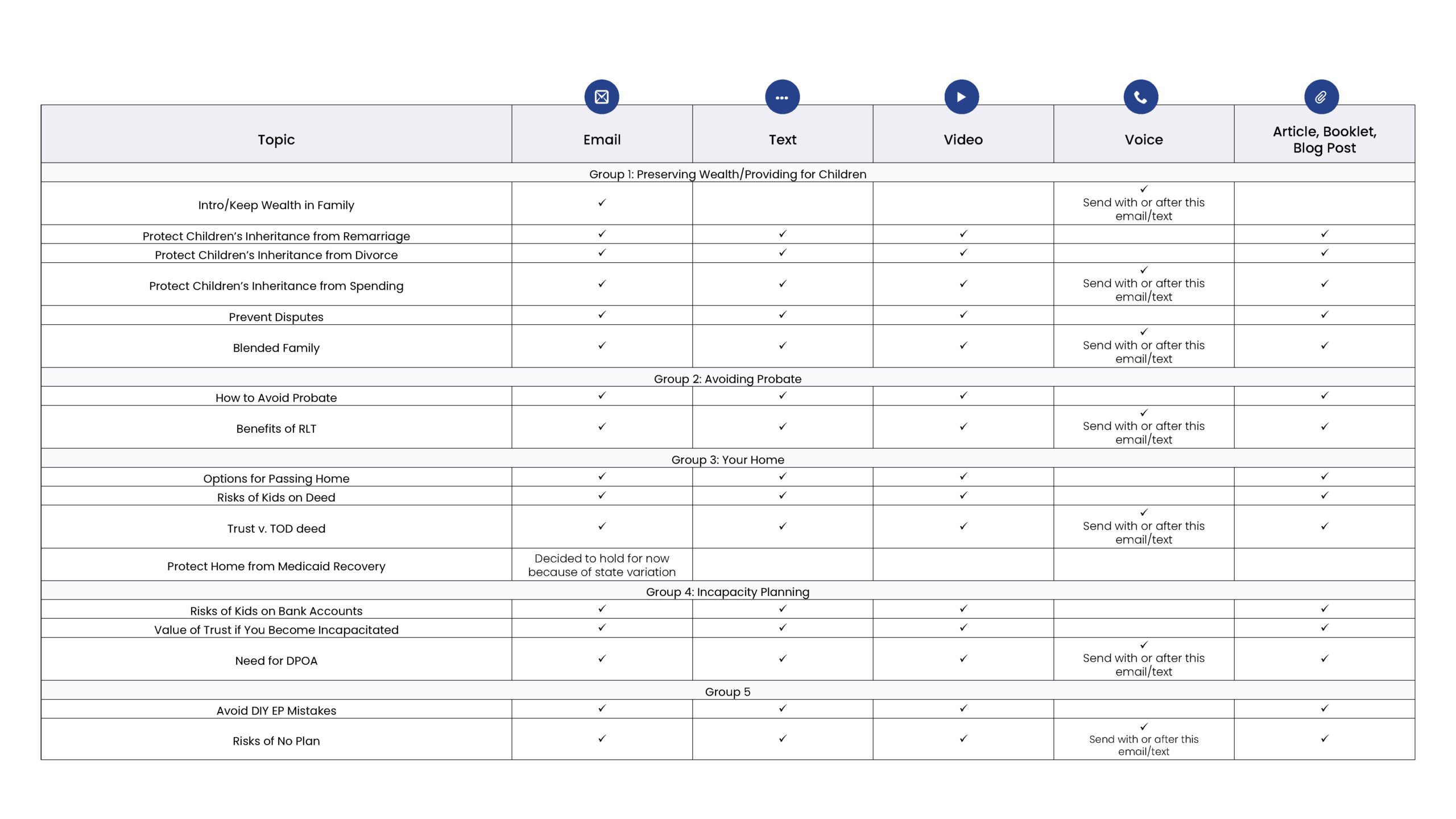
We can remedy it with either an omni-channel follow-up series or a simple email lead-nurturing series. Examples of both formats are displayed below.
Omni-channel follow-ups

Email follow-ups
Business litigation (16 emails)
Subject: How Strong Is Your Case?
When you consult an attorney about a business dispute, the first thing the attorney will do is evaluate your case to see if legal action makes sense. In deciding whether to accept your case, an attorney will weigh these factors:
- Can you prove the opposing party is legally liable to you? In other words, has the opposing party wronged you in some way that the law recognizes and do you have the evidence to prove it?
- Have you been damaged (i.e., suffered a financial loss) as a result of the other party’s conduct?
- Does the potential defendant have the ability to pay, either with its own assets or with insurance?
- How clear is the applicable law and is it on your side?
- Do you have favorable, believable witnesses?
- If insurance will be the source of damages, how conservative (settlement averse) is the insurer?
- Do you and your case have jury appeal?
- How do jurors in your area view litigation and how willing are they to award generous verdicts?
Case evaluation is an ongoing process. After an attorney accepts your case, he or she will continue to weigh these factors in evaluating settlement offers, in preparing for trial (or arbitration), and during the trial (or arbitration) itself.
Liability. Liability is the first hurdle a plaintiff’s lawyer will consider. There must be at least one legal theory (e.g., breach of contract) that fits the facts of your case. Many legal theories can potentially apply to business disputes. Often, a plaintiff can rely on more than one legal theory.
Damages.Liability can be clear, but if you or your business has suffered no damages, then, as a general rule, you have no case. The goal of plaintiffs in most business litigation is to get the defendant to pay for the losses it caused. However, the plaintiff also has an obligation to mitigate its damages, which means a plaintiff must take reasonable steps to keep its losses to a minimum.
Defendant with Assets or Ability to Pay. You may have a viable case if:
- The defendant has assets to satisfy a judgment; or
- nsurance is available to satisfy a judgment.
If not, you and your attorney may invest a good deal of time, money, effort and emotional energy in the case, but never see a penny in return.
Legal Issues. Is there a law or court ruling that applies to your case? If there is strong supporting law that your attorney can cite in your favor, the value of your case is enhanced.
Quality of Potential Witnesses.Your case is only as good as your evidence, and usually, your evidence is only as good as your witnesses. If, for example, your only witness to support liability is a relative or friend, your case is weaker than if you had several impartial witnesses.
Insurance Company.If the defendant has insurance coverage, the settlement philosophy of the insurer must be considered. Some insurance companies are far more conservative (i.e., tightfisted) than others.
Your Personality, Demeanor, and Jury Appeal. What kind of person are you? Will a jury like you? Will jurors empathize with your situation? What’s the reputation of your business in the community? What kind of person or business is the opposing party? The more likable you are and the less likable the defendant, the greater the value of your case.
Venue. Where will a lawsuit be filed? Jurors in some locales are more receptive to lawsuits and to large damage awards than jurors in other places.
Mandatory Arbitration Clauses. If your dispute arises from a written contract, the contract may preclude litigation. Many contracts contain mandatory arbitration clauses that require all disputes arising under the contract to be arbitrated.
For additional guidance about whether a lawsuit is a viable option for your situation, see my booklet, 5 Questions to Review with Your Attorney Before You Decide to Sue.
If you would like my assessment of your case, please call my office to schedule a consultation. I look forward to meeting you and learning how I can help.
Subject: Insurance Coverage Issues
Insurance carriers play an important role in many cases. They are often the only viable source of recovery for a plaintiff and payment of defense costs for a defendant.
Whether you are a potential plaintiff or defendant, one of your attorney’s first acts will be to explore the availability of insurance coverage. Businesses may hold a variety of different policies, including comprehensive general liability policies, errors and omissions coverage, directors’ and officers’ coverage, fiduciary bonds, and automobile policies. Individuals may also hold a broad array of insurance policies, including homeowners’ or renters’ policies, automobile policies, flood insurance, landlord policies, professional liability insurance, and umbrella policies.
If you or your business is the injured party, you may have insurance coverage that will provide some interim relief under first-party coverage. First party coverage provides monetary benefits to you in the event you have suffered from a covered loss or damages (e.g., fire, title, theft, and casualty insurance).
If you are a prospective defendant, you may have a third party liability policy that protects against liability to another based on the insured’s acts (e.g., comprehensive general liability policy, directors and officers liability policy, liability coverage in homeowners’ or renters’ policy, or an errors and omissions policy).
No matter which side of the lawsuit you may be on, your attorney will want to examine your insurance policies to see if there is any possibility of coverage and if so, make a demand on the carrier for coverage or a defense.
If you have a policy that could provide coverage for your or the other party’s losses, your attorney will notify your insurer, unless you have already done so. When an insured becomes aware of a potentially covered claim, it must promptly notify its insurance carrier. Failure to give timely notice can relieve the insurer of its obligations.
As a defendant, if your liability insurance potentially provides coverage for the plaintiff’s claimed loss, your insurer has a duty to defend you. An insurer must defend its insured against claims that create the potential for indemnity under the policy. If any facts give rise to a potential for liability within the coverage of the policy, the duty to defend is triggered even if coverage is doubtful, and ultimately not established. Any doubt as to whether the facts give rise to a duty to defend should be resolved in the insured’s favor.
If the insurance carrier defends you, it generally retains the right to control the defense, and the right to select your defense attorney. Absent a conflict of interests, an attorney retained by an insurance company to defend its insured owes fiduciary duties to both the insurer and the insured. If the insurance carrier reserves its right to claim that the action is not covered, you may have the right to retain your own separate attorney paid for by the carrier, which is known as cumis counsel.
Divorce (10 emails)
Subject: Finding the Right Attorney to Handle Your Divorce
If you are considering divorce, one of your first steps should be to find a good lawyer. Even if you have not made the final decision yet, you will benefit from getting some advice and information. A conference with an attorney will help you understand the divorce process, the cost, possible outcomes, and things you should do and not do to protect yourself.
If your spouse has already engaged a lawyer, you should get one too. One attorney cannot represent both parties to a divorce even when you and your spouse have agreed on everything. Although it is sometimes possible to handle a divorce without an attorney, representing yourself is not advisable when your spouse has an attorney and you don’t agree to everything your spouse wants.
You may have used an attorney in the past for some other purpose (a will, traffic violation, tax question, to incorporate your business, etc.). You probably do not want to hire this person to handle your divorce. You want an attorney who focuses his or her practice on family law, someone who handles a significant number of divorces every year.
When you meet with a prospective attorney for the first time, you may want to ask the following questions:
- How long have you been in practice?
- What proportion of your practice is devoted to family law? How many divorces have you handled in the past 6 months?
- How often do you represent the wife? The husband?
- How many cases have you handled that involve [specific issues in your case: high assets/complex finances; suspected hidden assets/illegal activity; a family business; a professional practice; bankruptcy; tax issues; high conflict between parties; contested custody; substance abuse; domestic violence]?
- Will you be handling my case exclusively or will other attorneys at your firm also be working on my case? If so, who are they and can I meet them?
- What is your general philosophy on divorce cases? What proportion of your cases do you resolve through settlement and what proportion through trial?
- How will I be billed — hourly or by the case? What is your rate? Will I be charged a different rate for court appearances? How often will I be billed? What charges, other than your time, am I responsible for? Do you require an initial retainer and, if so, what is the amount? Will you ask me to sign a retainer agreement that spells all this out?
- What are your office hours? What are the best times and ways to reach you? How can I contact you after hours with regard to an emergency? How long does it typically take you to respond to a client?
If you are not comfortable with any of the attorney’s answers, continue looking. You need an attorney in whom you have complete confidence to guide you through this most stressful time.
Please contact my office if you would like to set up a consultation. I am ready to answer your questions and learn what I can do to help.
Subject: Writing a Marital History for your Lawyer
To represent you properly, your lawyer will need to know a lot about you, your spouse, your children, your property, and the reasons why you are seeking a divorce. One way to provide your lawyer with this information is by writing a marital history.
Why Your Lawyer Wants a Marital History. This information will help your lawyer understand how your marriage worked or did not work, what outside influences have contributed to your marital problems, and especially, what barriers your lawyer may face in assisting you and your spouse to amicably resolve your divorce.
What to Write About. Your lawyer can best protect you and your interests by knowing as much as possible about you, your spouse, your family, and the conflicts and problems that have lead you to divorce as possible. The more you include — the better. Take your time. Our booklet Writing a Marital History provides a worksheet that explains each of the topics you should address:
- A chronology of your relationship with your spouse
- Role of family and friends in your life
- Education of yourself and spouses
- Growth and development of your children
- How you share parenting responsibilities
- Parenting conflicts
- Employment history of you and your spouse
- Finances and financial conflicts
- Gifts and inheritances received from families
- Your assets and debts
- Counseling and therapy you, your spouse, or family has participated in
- The causes of the breakdown of your marriage
- Major life events that affected your marriage
- Health histories for yourself, spouse, and children
Keep It Confidential. Do not discuss your marital history document with anyone other than your lawyer or allow it to be on a computer that can be accessed by your spouse. If you decide to handwrite it, secure it in a place that is inaccessible to your spouse.
Drunk driving (12 emails)
Subject: Finding a Good Lawyer to Represent You
You may be wondering if you really need a lawyer. The answer is “yes.” Although you can represent yourself, no one familiar with the drunk-driving legal process would advise it. A few of dozens of reasons are: (1) the prosecutor will have no incentive to offer you a reasonable deal, (2) you will be unable to competently represent yourself in court, (3) your lack of experience is likely to make a bad situation worse, and (4) you will be unable to recognize when you have a valid defense.
After a drunk driving arrest, you need to move quickly to retain a good lawyer. The number one reason is your driver’s license suspension hearing. You have only a short time to request a hearing. You don’t want to miss the deadline for requesting the hearing because you want your lawyer to help you retain as many driving privileges as possible.
The second reason for moving quickly is the prosecution’s head start. The police and prosecutor already have the evidence they need to prosecute you. Your lawyer is coming to the battle late and needs as much time as possible to do a good job.
Searching the Internet is a good way to find local lawyers who handle drunk driving cases. Checking the About Me or About Us pages of the drunk-driving lawyer websites can tell you a lot. Look for indications that the lawyer spends a healthy portion of time on drunk-driving defense. The law is too complex for dabblers.
Once you find a promising candidate, ask these questions:
- Will you be personally handling my case?
- What percent of your time is devoted to drunk-driving defense?
- How many years have you been handling drunk-driving cases?
- How many drunk driving cases did you try last year?
- What results did you obtain?
- Is your initial consultation at no charge? What does your quoted fee cover?
- Are investigators, subpoena costs, the license suspension hearing, expert witnesses, and any blood re-analysis extra?
- What is your fee for taking my case to trial?
Listen carefully when the lawyer provides feedback on your case. Beware big promises. You want a lawyer who honestly compares the risks of trying your case with what a likely plea bargain will bring. Candor is what you want; not a sales job.
If you would like to meet with me to talk about your case, please call my office to schedule a consultation. I am committed to providing all my clients with a zealous defense.
Subject: License Suspension Administrative Hearings
When you are arrested for drunk driving, two cases are started against you: the criminal case and the driver’s license suspension case. Although it seems unfair, the state licensing agency can suspend your driver’s license before you are found guilty in the criminal case.
You are entitled to an administrative hearing before the suspension takes effect. When you are charged with drunk driving, the police should give you a written notice that your license will be suspended unless you request a hearing. The time for making the request is short; a week to ten days is the norm. Do not ignore the deadline. If you do, your license will be suspended automatically even if you have a winnable case. Hire a lawyer immediately to request the hearing or request it yourself if you haven’t got a lawyer yet.
Administrative hearings are less formal than criminal trials. The rules of evidence that apply in criminal court are usually not applicable in administrative hearings. Furthermore, the state has to prove its case beyond a reasonable doubt in criminal court, but in an administrative hearing, the state may only have to prove its case by a preponderance of the evidence, which means more likely than not.
Even if it is not possible to prevent your license from being suspended, it’s still important for you to get a hearing. Your lawyer can learn a lot about the state’s case against you by cross-examining the arresting officer at the hearing. This knowledge will help your lawyer advise you about whether to accept a plea or go to trial. It will also help your lawyer present the strongest possible defense if you do have a trial.
If you have been arrested for drunk driving, don’t miss the deadline for requesting your administrative hearing. Please contact me as soon as possible to schedule an initial consultation.
Estate planning (20 emails)
Subject: Can You Prepare Your Own Estate Plan?
The prevalence of do-it-yourself options for drafting estate planning documents leads many people to wonder whether they can prepare their own estate plans. For all but the simplest estates, however, writing your own estate plan is not a good idea. Estate planning is not a one size fits all model.
These do-it-yourself forms, whether found in books or online, are generated by estate planning computer software that is designed to cover only the most basic of estate planning needs. Even books and programs about estate planning recommend that you seek the expertise of an experienced estate planning attorney.
Self-drafted estate planning documents are notorious for mistakes. Some common problems include:
- Making a gift of one or more specific assets to a particular person without considering what will happen to that person’s inheritance if you no longer own the asset when you die. As a general rule, if your will attempts to give away an asset you no longer own, the gift lapses and the beneficiary isn’t provided with an alternative gift.
- Not providing alternative beneficiaries who would take if the first named person predeceases you. In this case, do you want the deceased beneficiary’s gift to go to his or her heirs or to someone else?
- Failing to provide for what should happen to property in your estate that you have not specifically mentioned in your will. The property could be omitted through oversight; it could have been acquired after the will was drafted; or its intended beneficiary could have predeceased you and you did not name an alternate.
- Failing to provide for the possibility that you may have more children after executing your documents. States have laws designed to protect children born after a will is executed from being unintentionally disinherited. These laws vary and are not a guarantee.
- Not executing your estate planning documents with the legally required formalities.
A document that is improperly executed is not valid. In most states, a will must show the testator’s intent to make a will; the testator must have testamentary capacity; the will must be signed by the testator in the presence of two witnesses who watch the testator sign the will and then sign it themselves. The witnesses must also be disinterested parties, which means they are not beneficiaries under the will. Other estate planning documents require similar execution procedures.
Estate planning is a complex endeavor that puts clients at risk for many mistakes. Working with an experienced professional will ensure that you avoid them.
Subject: Providing for Minor Children
If you are a parent of minor children, one of your estate planning priorities may be to leave an inheritance for the children. Leaving an inheritance directly to a minor creates a problem. Minors cannot own more than a few thousand dollars worth of property outright. Larger amounts must be under adult management. If your trust or will leaves substantial property directly to a minor, a court proceeding will be necessary to appoint a guardian or conservator to oversee the property. A court proceeding is undesirable because it will take time, cost money, could cause conflict if different people vie for the appointment, and leaves you no say in who is appointed.
Better options for leaving an inheritance to a minor are:
Leave the gift to one of the child’s parents with the understanding that the parent is to use it for the child’s benefit. Married parents frequently choose this alternative. Each leaves all his or her property to the other in a will or living trust with the understanding that it will be used to support the family. Obviously, this alternative won’t work if the child has no surviving parent or the other parent is financially incompetent or untrustworthy.
Name a custodian under the Uniform Transfers to Minors Act (UTMA) to manage the gift. Most states have enacted this law. In your will or living trust, you specify that you are leaving the inheritance to the custodian for the child’s benefit under your state’s Uniform Transfers to Minors Act. The custodian can manage the property without court supervision. However, he or she must manage it prudently and spend it for the child’s benefit. Once the child reaches the age specified in the law (18 or 21 in most places), whatever is left belongs to the child outright. This method is simple and cost-effective. The main drawback is that the custodianship must terminate at the specified age. If you expect the child’s inheritance to be large, you may not want him or her to get it outright at such a young age.
Leave the gift in trust for the child to be managed by the trustee. You can set up a trust for minor children in your will or living trust and name a trustee to manage the inheritance. The two principal types of trusts that are used to leave property to minors are the “minor’s trust” and the “family pot trust.” A minor’s trust is established for one child. The property you leave to that child goes into the trust and the trustee must use it only for that one child’s benefit. You can establish a minor’s trust for each child and you can choose the age at which the trust terminates. A family pot trust is established for two or more children. The trustee has the discretion to take money from the “pot” for the needs of each child as they arise. A pot trust it allows the trustee to make unequal distributions to the beneficiaries as their needs may require. Once all of the children have reached a specified age, the trust pot is usually divided into separate shares for each of the children.
Name a guardian to manage the child’s property in your will. This method has a few drawbacks. The guardian may be subject to court supervision, which can increase the cost. The guardianship ends at 18. And the property must go through probate (which would not be necessary if it passed through a revocable living trust to an UTMA custodian or minor’s or pot trust). However, it does allow you to choose the property manager.
I look forward to meeting you and learning about how I can help you create an estate plan that satisfies your wishes and your family’s needs.
Injury (17 emails)
Subject: When the Claims Adjuster Says …, He Really Means ….
If you ever have tried to negotiate with an insurance claims adjuster, then you know that (1) claims adjusters are highly skilled negotiators; and (2) claims adjusters speak their own language (or, at the very least, speak a different language than you). All you want is a straight answer, but the adjuster never seems to say what he actually means!
The reason for this disconnect is simple: You and the adjuster have different goals. You want to settle your claim for a fair sum in a reasonable amount of time. The adjuster, on the other hand, wants to settle your claim for as little as possible, regardless of how long that takes.
You don’t have to be trained in the art of negotiation to achieve your goals, but you do have to recognize when the adjuster is employing a particular negotiating technique in an effort to achieve his goals. To help you with that, we’ve put together a handy cheat sheet: When the Adjuster Says …, He Really Means …. You can view it here.
We hope you find the cheat sheet helpful in dealing with the claims adjuster. If you would like to speak to a compassionate and experienced personal injury attorney – one who understands your goals and knows how to talk to the claims adjuster in a way that gets results – please call us.
We wish you well.
Subject: What is stonewalling? How should I respond?
Does it seem like the insurance adjuster is dragging his feet on your personal injury claim? It may be that the adjuster is stonewalling you – that is, deliberately delaying the settlement of your claim in an effort to wear you down until you are willing to accept a low offer just to put an end to the frustration. Stonewalling can take many forms, including:
Silence.
This is, perhaps, the most frustrating stonewalling technique. The adjuster simply stops communicating with you. He does not respond to letters or emails or phone calls.
“I don’t have authority to settle for the amount you have requested.”
It is the nature of an insurance claims department that the adjuster has to get authority to settle from someone higher in the chain of command. If, however, the adjuster makes this claim repeatedly, you are probably being stonewalled.
“Your claim is being reviewed.”
Even though no settlement offer has been made, the adjuster assures you that the wheels are in motion: Your claim is “in committee,” or “being reviewed by the home office,” or “waiting for a supervisor’s approval.” By dangling the carrot of a pending settlement, the adjuster hopes you will continue to wait.
“I need more proof.”
The adjuster has copies of all your medical records and bills, and evidence of your lost wages, but says he needs “additional documentation” of your loss. If no offer is forthcoming, these repeated requests for documentation are a blatant effort to delay payment of your claim.
“I’m just getting up to speed on your file.”
Some insurance companies have a high turnover rate among claims adjusters; some insurance companies routinely move claims files from one adjuster to another. If you are constantly dealing with a new claims adjuster, for whatever reason, the effect is to stonewall your claim and delay payment while the adjuster learns the file.
“We can settle all of your claims or none of your claims.”
The adjuster may try to leverage one claim against another. If, for example, you have an auto damage claim and a bodily injury claim, the adjuster may refuse to settle your auto claim unless you also settle your injury claim (right now, for a low amount).
If you encounter one or more of these tactics in your dealings with the insurance adjuster, you have a few options:
- You can wait and let the negotiations play out on the adjuster’s schedule for a while longer;
- You can challenge the adjuster directly by sending a formal settlement demand letter, by certified mail, requesting a response by a set date; and/or
- You can enlist the help of a personal injury attorney. Depending on how much time has passed, this may be your best option. Insurance companies have little incentive to settle promptly and fairly with unrepresented claimants. Stonewalling is profitable for the insurance company. Accordingly, it often takes the involvement of an attorney to get the adjuster’s attention and set the negotiation wheels in motion.
When you are ready to discuss your case with a personal injury attorney, please call us to schedule a free, no-obligation initial consultation.
We wish you well.
